Tom Holland and Richard Bauckham: An Eyewitness to Revolution
A shorter version of this article will be printed in the Easter edition of The Anglican Planet. For better or worse, below is a longer version of that same article. The point is the same, but now with more words!
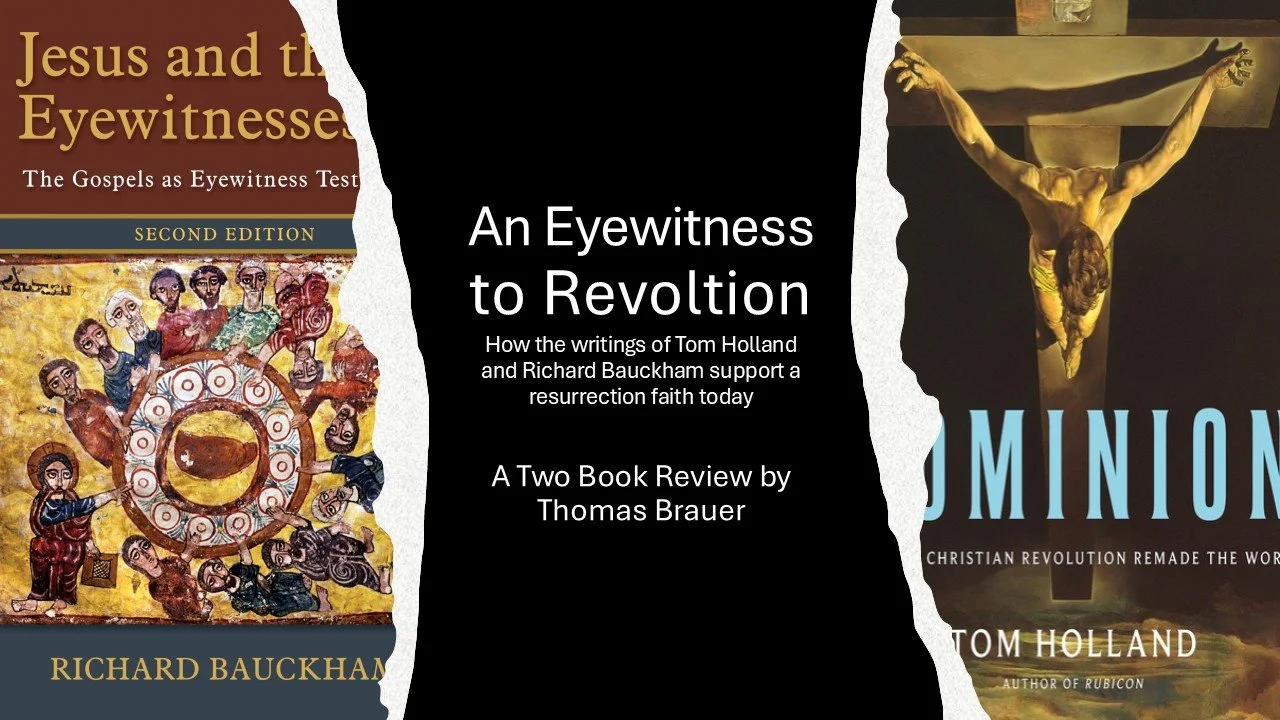
An Eyewitness to Revolution:
How the writings of Tom Holland and Richard Bauckham support a resurrection faith today
Tom Holland, Dominion: How the Christian Revolution Remade the World. (Basic Books, NY, 2019. Trade paperback, 2021). 609pp. with Index and endnotes. $29.99 CAD (Amazon). US edition. In the UK, published under the title: Dominion: The Making of the Western Mind.
Richard Bauckham, Jesus and the Eyewitnesses: The Gospels as Eyewitness Testimony, First Edition. (William B. Eerdmans, Grand Rapids MI, 2006). 538pp. incl. indexes. $94.98 CAD (Perfect Paperback) (Amazon). 2nd edition, 2017 adds 3 chapters, new preface, and new bibliography. $71.97 CAD (Amazon).
Prologue
It is unusual to write a review of two books at the same time. My intent, however, is to not write complete reviews of these two works, but to write a brief review of how the lessons they contain overlap in support of the apologetic enterprise. I’m intending this to be the first of three brief papers. The second, like this, will look at two otherwise unconnected works and discuss how they overlap: a well established work by NT Wright, The New Testament and the People of God (1992), and a new release from Gary Habermas, On The Resurrection Volume 1: Evidences (2024). The third essay will examine how all four works together strengthen Christian confidence in the stories of the Resurrection as God’s transformative act in history.
Dominion
Tom Holland’s Dominion is a book that thumps when you put it down. Over 600 trade paperback pages of historiography spanning two-thousand years of Western history as it has been influenced by one Jewish-Palestinian man and his followers: Jesus of Nazareth. This book primarily describes the changes of culture that followed the rise of Christianity and its movement into Europe to the present day. In answer to the question, ‘How was it that a cult inspired by the execution of an obscure criminal in a long-vanished empire came to exercise such a transformative and enduring influence on the world?’ (p.12), Holland dedicates 21 chapters in three parts: “Antiquity”, “Christendom”, “Modernitas”. While pursuing his answer, Holland often writes with clear admiration for many Christian leaders, thinkers, and missionaries, yet he pulls no punches when those same individuals (and the communities to which they belong) betray their own convictions. His concluding paragraph itself is both an indictment and a defense:
Many of them [Christians], over the course of this time, have themselves become agents of terror. They have put the weak in their shadow; they have brought suffering, and persecution, and slavery in their wake. Yet the standards by which they stand condemned for this are themselves Christian; nor, even if churches across the West continue to empty, does it seem likely that these standards will quickly change. ‘God chose the weak things of the world to shame the strong.’[1 Cor 1.27] This is the myth that we in the West still persist in clinging to. Christendom, in that sense, remains Christendom still. (p. 542)
As Holland moves from his initial question to his concluding claim, most chapters offer a before and after contrast outlining a progressive cultural shift toward the conviction that God did indeed choose the weak and shame the strong. He often demonstrates this shift through specific examples which are then followed up with more general discussion of the changes that occurred in a particular phase of development in Western society. For example, in Chapter 4, “Belief, AD177: Lyon,” Holland begins in the adventuresome tones classic to his story-telling style (a style which makes the book eminently readable for all its length and breadth): “The churches of the Rhone Valley were on the rack. News of their agonies could not help but shadow Irenaeus as he set out on his journey,” (p. 107). He continues in this chapter to outline Roman influence in Gaul, Irenaeus’ Asian-Christian heritage, and how these two influences encountered Gaulish paganism as Irenaeus exercised his episcopal ministry and evangelistic mission. Holland concludes this chapter by outlining the changes in Gaulish Europe that would follow over the next two hundred years.
Ultimately, Holland’s subtitle for his book is itself the conclusion. Christianity brought revolutionary change that made the Western world as we currently know it. He demonstrates how the values and philosophies common in contemporary, Western, liberal democracies are direct products of belief in one radical idea and one extraordinary event: that Jesus of Nazareth was the incarnate God, and that the incarnate God died on a cross and rose from the grave. (To be clear, he is not claiming that modern western democracies accept this belief, only that the belief itself is the foundation of its values and standards.) Without these teachings of Christianity, there is no scientific revolution, there is no liberal democracy. There is no ‘woke-ism’ or “#MeToo.” No end to slavery, no civil rights movement, no concept of international law or human rights. It is the teaching that power is found in weakness made evident upon the cross and triumphant in the resurrection that transforms Europe. Holland even argues that it is this very transformation that Adolf Hitler rejected as he followed Friedrich Nietzche in calling for a return to “traditional European” values and culture; desiring to rid Europe of the “weaknesses” caused by the foreign influence of Christianity. (pp. 464-5).
Holland’s argument is simultaneously cogent, enthralling, and convincing. One critique might be that his desire to demonstrate the origins of liberal Western values has led him to de-emphasise those of a traditional Conservative (or conservative) economic, social, or political bent. Such individuals might struggle to find their own philosophies and values discussed significantly by Holland, particularly in the final two chapters.
Jesus and the Eyewitnesses
Where Holland is interested in the origins of contemporary Western cultural values as they develop out of the Christian story, Bauckham’s interest is in the reliability of the story tellers; can we trust that the Gospels that tell the story of Jesus are founded on Eyewitness testimony, and can we trust that such testimony is reliable?
With the post-enlightenment rise of biblical criticism came a precipitous decline in confidence in the biblical witness. The dominant assumptions of form criticism portrayed the Gospels as evolving traditions shaped primarily by the needs of distinct early Christian communities. Bauckham raises major challenges to these assumptions (see Ch. 10, “Models of Oral Tradition”, p 240ff, and more generally, Ch. 1, “From the Historical Jesus to the Jesus of Testimony”, p. 1ff). Against the form-critical model, Bauckham argues (and offers evidence) that the Gospel traditions originated with named eyewitnesses whose testimony was carefully preserved and transmitted. These eyewitnesses, he contends, were not passive sources but active guarantors of the tradition while they remained alive.
Throughout the eighteen chapters and over 500 pages of dense discussion (not including the extensive indexes), Bauckham argues not only for individual, eye-witness guarantors, but also for the reliability of memory (Ch. 13, “Eyewitness Memory”). In his usually dense style, Bauckham argues ‘The impact of the past…along with a conviction that the past history of Jesus mattered as past event, gave stability to their memories long after the crucial theological developments that took place in the earliest Christian circles.” (p.355) Bauckham draws heavily on contemporary psychological research to show that eyewitness memory embedded in communities that value exact transmission is more accurate than many critics assume. It is because Early Christians were certain that the events of their stories were real that they regarded those events as theologically significant. And this conviction stabilized memory and discouraged creative embellishment.
Having shown the trustworthiness of the first-generation storytellers, Bauckham continues by tracing how the reliability of the stories continues into later generations through “recognized teachers” who functioned as “authorised tradents”. Having received the stories/traditions directly from the eyewitnesses these authorized teachers were responsible to faithfully share the stories as they had learned them, training up future authorised and recognized teachers (see p. 280 ff.). Bauckham summarizes much of his argument this way:
Of curial importance for our whole argument in this book is the role of individual authors and tradents of Jesus traditions. We have suggested that the traditions were originated and formulated by named eyewitnesses, in whose name they were transmitted and who remained the living and active guarantors of the traditions. In local Christian communities which did not include eyewitnesses among their members, there would probably be recognized teachers who functioned as authorized tradents of the traditions they had received from the eyewitnesses either directly or through very few (authorized) intermediaries. (p. 290)
The above quotation demonstrates the significant diversion Bauckham takes from the form critics and other voices in gospel scholarship. This outline of the development of gospel story telling provides a foundation upon which trust in the received Gospels can be built. By demonstrating the reliability of eyewitness memory, testimony, and testimonial transmission, as well as extensive discussion from historical evidence outlining who the eyewitnesses of the gospels were, Bauckham builds a convincing case for the accuracy of the gospels for both the person of faith and for the historian of first century Palestine.
As Tim Keller wrote, “…[Bauckham] gives the best evidence for how the Gospels were eyewitness accounts and not fabricated stories. It is so well reasoned there have been few critiques in the past 10 years that have really challenged the work. It’s an important work to know.” (Tim Keller on Facebook, June 5, 2017).
Review Wrapup
Bauckham’s style, in contrast to Holland’s, is highly academic. Holland is clearly writing for a popular audience, including many stories told accessibly, and with a sense of adventure that constantly raises the question “What happens next?” Bauckham is writing a textbook full of dense, technical language with countless footnotes and references to other scholars. Both books have a clear thesis and both argue their points from robust research and evidence exceedingly effectively. Jesus and the Eyewitnesses will appeal most to students and scholars of the New Testament comfortable with dense academic writing. Dominion, on the other hand, will appeal to an armchair student of history, society, and culture regardless of theological perspective, level of education, or religious affiliation.
Holland plus Bauckham: A five-paragraph essay in support of an apologetics of the resurrection
In the very first pages of the preface to Dominion, Tom Holland lays out a description of the horrendous display of mass curcifixions at the Sessorium on Rome’s Esquiline Hill (p1ff). From the stench and torment of this site (and sight) of Roman cruelty, through the similarly cruel practices of the Persians and the Greeks (pp. 22-23), to the violent, lascivious, and coercive Gods of Greco-Roman devotion and the self-violence and mutilations performed in worship of them (pp. 30-36; see also details of Galatian veneration of Cybele, pp. 83, 137-8, 162), Holland demonstrates the operating paradigm of pre-Christian Asia and Europe as Thucydides declared it, ‘The strong do what they have the power to do, and the weak must suck it up’ (p. 41, ref. Thucydides 5.81). Yet, over and over again, wherever Christianity encounters paganism in Europe, the story takes on the echoes of the Magnificat as people forsake their old gods and begin to believe in a God that died upon a cross:
My soul magnifies the Lord,
and my spirit rejoices in God my Saviour,
….
He has scattered the proud in the thoughts of their hearts;
he has brought down the mighty from their thrones
and exulted those of humble estate;
he has filled the hungry with good things,
and the rich he has sent away empty.
For such a change to occur, for a culture to shift from a might-makes-right understanding of power (because that’s how the gods do things), to a belief that humility is godly and good, requires an overwhelming shift in fundamental beliefs, philosophy, and cosmology. For the old gods to be forsaken and replaced with the God that died on a cross and rose from the dead three days later, people must have believed that the crucifixion and resurrection of Jesus of Nazareth actually occurred. Early Asian, Roman, and Greek adherents to the Jesus story could not have believed the story was the wishful fabrication of an isolated community in Roman occupied Palestine. To grant the courage to go against the gods, this story could not be the hysterical imaginings of a small group of grieving disciples. For the first adherents, those who fist heard the stories of Jesus’ resurrection, the cruel and capricious gods needed to be put away because they understood and believed that the God of the humble had overwhelmed them by turning coercive power into weakness – the cruciform cruelty of the pagan world and pantheon is demonstrably broken when the crucified God bursts forth from the “spic-ed tomb”. Jesus is risen, the gods have fallen.
Bauckham lays out a very different kind of story, but one that supports Holland’s. Jesus and the Eyewitnesses connects the dots from the words, actions, and resurrection of Jesus to the readers and hearers of the Jesus story. But Bauckham does not merely lay out a line of connection, for that has been done countless times before. Rather, the uniqueness of his work is to demonstrate the trustworthiness of the line itself. Bauckham outlines a story of how the followers of Jesus likely bore witness to what they saw and heard of Jesus, then shared their testimony with others in a way that could then be shared again and again while those same eyewitnesses were present to make sure the story was told correctly. The written narratives, the Gospels, were then made to share the testimony of the witnesses accurately and correctly to generations that would no longer have the eyewitnesses present to tell of what they saw. This story is supported significantly by evidence from scientific sources (e.g., studies of the brain and memory), historical sources (e.g., the writings of Plotinus, Eusebius, et al.), sociological sources (e.g., studies on how story is transmitted within cultures, how societies share and preserve eyewitness testimony). Over and over again, Bauckham demonstrates that the basis of the Gospels is the testimony of eyewitnesses, and how the aural and written transmission of eyewitness testimony of Jesus creates a direct, and reliable link from the reader/hearer of the story back to the life, death, and resurrection of Jesus.
Holland gives us an outline of what happened when the story of Jesus’ death and resurrection was believed – how cultures changed, and old gods were overturned. Bauckham gives us an outline of why the story was believable to the peoples that received it – why the story they believed was trustworthy to the point of giving up all other faiths. Reading these books together, we are left with a core apologetical insight: there is no other explanation for the culture we have except that the story of the gospels is trustworthy and true; Jesus really did rise from the grave. If the story were not trustworthy, why would the early Christians give up everything, even their lives (not a new question, but one foundational to the next)? If the story were not trustworthy, why would the Romans become ‘atheists’ and deny their gods? It the story were not trustworthy, why would societies founded on the powerful doing what they want while the weak suck it up become societies that uphold the poor as special to God? The only reason that the story of the resurrection of Jesus could possibly have had the overwhelming cultural, moral, and societal change that Holland describes is if the ways that story was told were trustworthy and accurate as Bauckham describes. And the proof that both Holland’s thesis and Bauckham’s thesis are correct is our own society as we live it today.
While many people of Christian faith look to society today with despair, seeing a falling away from faith as churches drain into the streets and fail to fill again, we remain with more that is hopeful than despairing. We remain with a story that is true and trustworthy. We remain with evidence of radical transformation that could only have happened because the story is true and trustworthy. We remain (if you will forgive the sermonic tone) with a God who really did show up, and who shows up still through the story, through the people who hold the story as joyful truth, and through the faith that transforms lives and cultures. And we can take hope that the story that convinced the Romans, the Greeks, the Gauls, the Britons, the Franks, the Germans (and so many more peoples than I can count) to give up their cruel and capricious gods and their cruel and capricious ways, has the power to convince today’s cultures of new-atheism, scientism and neo-paganism to do the same.
Epilogue
There is a story, likely apocryphal, that tells of an early 20th century vicar and his encounter with a West End actor in London. The story goes that the vicar was walking in the West End after yet another Sunday service with too few congregants in the pews, when he nearly bumped into the famous actor on his way to the theatre in advance of a matinée performance. In frustration, the vicar demanded to know “Why is it that on Sunday morning my pews are empty, but on Sunday afternoon, your seats are full?” The actor paused, but only briefly, and replied, “Because, sir, I tell lies as if they were true, and you tell the truth as if it were a lie.” For nearly 2000 years the truth of the story was clear, and countless cultures were transformed by it. Today, the truth of the story is in doubt. Has something changed in the ways we tell the truth?