The Gaze

This brief article is a cursory look at the idea of “The Gaze”. I recently did some teaching on this subject for a photography retreat that emphasized the Psalms, and the notes included here were the foundation of that talk. This is not intended to be comprehensive, not even close. Just some summary statements and observations. I recommend you read Psalm 36 before reading this posting. It will help. Especially if you notice how the “arrogant” see by their own light in contrast to those who see by the Light of God that reveals all light…”by your light, we see light.”


The Gaze

How we see is as important as what we see. Taking the poetic and theological lessons of Psalm 36 to heart, one might understand the Gaze in the following way:

Light reveals what-is-there. Light reveals, but is not itself visible.

When we look at something that interests us… (photographically speaking)

…we see the physical by means of a physical light source. The physical light exists and illuminates only because God created it. We can only see by light because God who is Light created lights to see by. (A material transposing of “by your light we see light”.)

…we see the spiritual by means of a spiritual light source: arrogance or steadfast loveThe physical light exists and illuminates only because God created it. We can only see by light because God who is Light created lights to see by. (A material transposing of “by your light we see light”.)

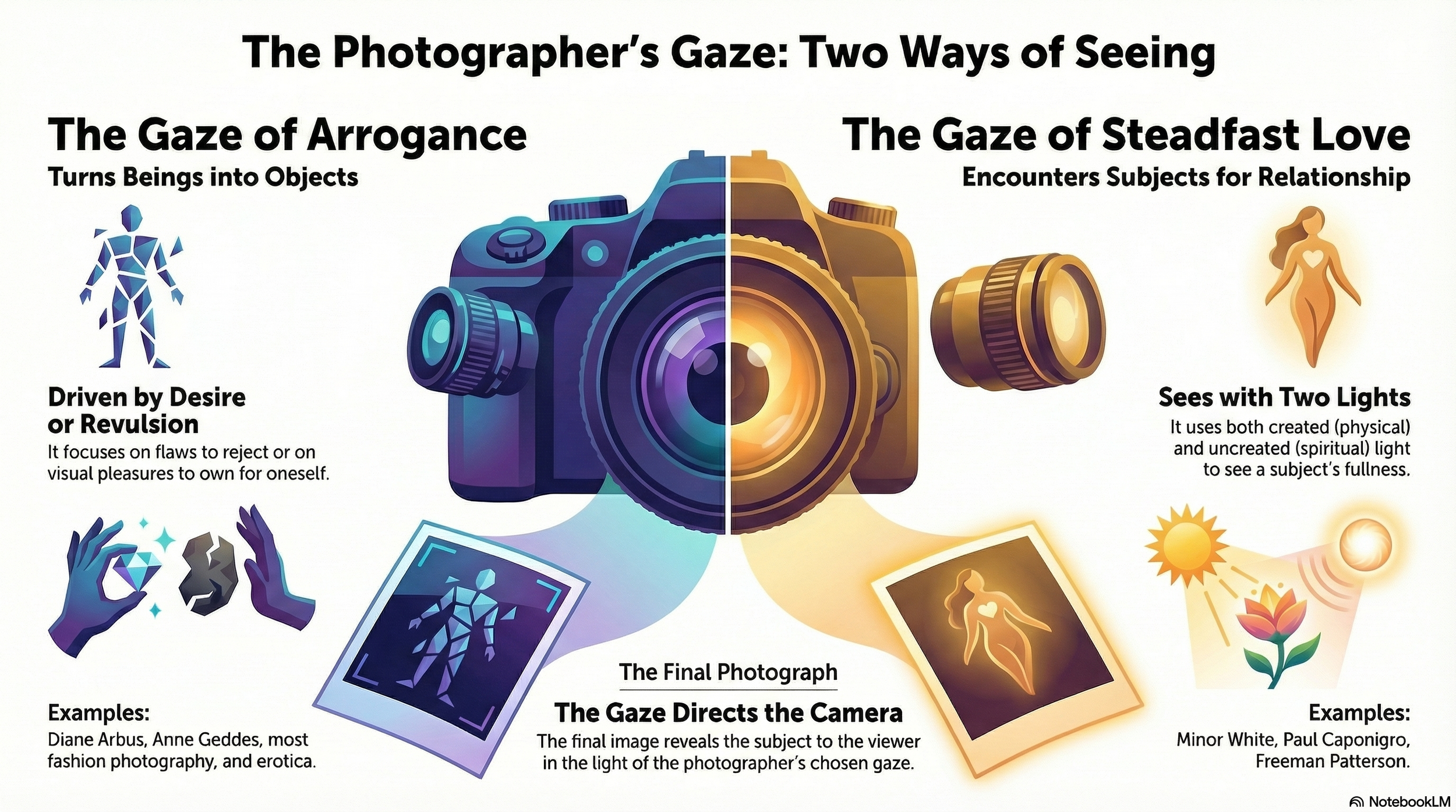
When we contemplate what we are looking at, “looking” becomes “gazing”. The gaze can be filtered through the darkness of arrogance (Ps. 36:11) or through the light of steadfast love (v.7).

When “arrogant”, the gaze tends to objectify… 

…turning what is looked at into an object to be repelled… The gaze can focus on the desire to reject what is seen, a desire that arises from the faults or flaws, the things that disgust, divide, reject, or separate (e.g., photographers Diane Arbus, Joel-Peter Witkin). 

…or an object to be possessed (v.11). The gaze can focus on the desire to possess that arises from visual pleasures, the things that attract, entice, allure, sentimentalize; what one wants for oneself  (e.g., photographer Anne Geddes, most fashion or product photography, most erotica, all pornography).

The object of the arrogant gaze becomes caught in the mythology of the viewer (as Roland Barthes describes it) or the sentimentality of the viewer (as Mary Midgley describes it), forever a signifier of the viewer’s power over it (whether revulsion or desire).

When of “steadfast love”, the gaze tends to subjectify, facing what is seen and discovering there a subject to be encountered for relationship and care, desiring to know rather than repel or possess. The created light reveals a creature of form and matter (therefore able to be cared for or harmed) that was created with and for purpose, intentionally placed for the love of the world. The uncreated light reveals a creature in perpetual relationship with God in whose light their fullness is known and steadfastly loved and in whose shadow they can seek refuge.The subject of this gaze is set free from the mythologies and sentimentalities of the viewer and of the world, forever revealed in the light and life of God who delights in their being and who fully and truly knows them (v. 10). In this mode of the gaze, a photographer has the opportunity to add their love to the love of God for the subject (e.g., Photographers Minor White, Paul Caponigro, Freeman Patterson).

The Gaze then directs the photographer’s camera to reveal the object/subject to the photograph’s viewer in the light of that gaze. We have no choice but to see in these ways, though our culture has done a good job convincing us that the spiritual light and sight are merely “imaginary,” or “mythical,” or are reducible to ethics (i.e., made up in order to delude oneself, or made up in order to control others, or used to shape, correct, or commend behaviour) . Human beings will always be tempted to gaze with arrogance and will often instinctually err in that direction. However, by God’s grace through the renewing of our minds in Christ Jesus (Romans 12:2; Philippians 4:8) and the power of the Holy Spirit (Galatians 5:22-24), our instincts can be overcome, and we can choose to live out the gaze of steadfast love.

The Photographer's Gaze | Infographic AI generated by NotebookLM